Demographic Migration Patterns in Mobile Poker Variants and Live Dealer Table Formats
Written by Erik Krüger · Aug 26, 2026
Demographic Migration Patterns in Mobile Poker Variants and Live Dealer Table Formats
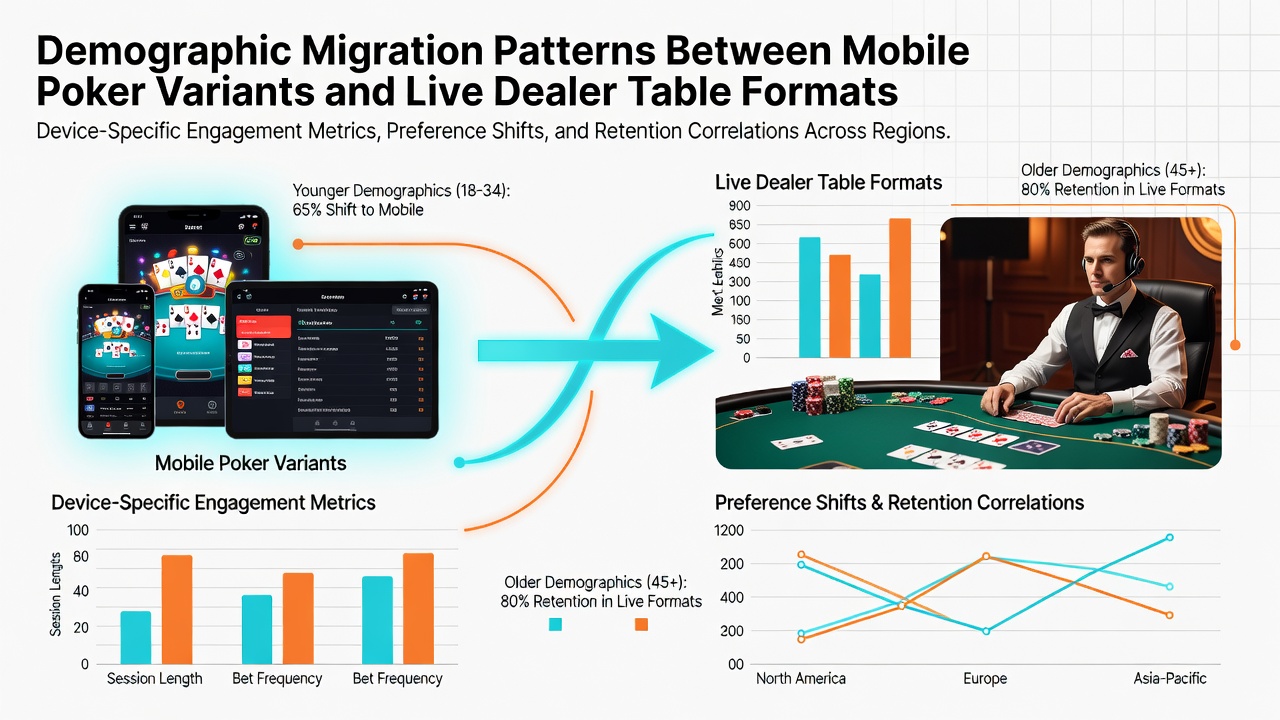
Platform data collected through mid-2026 reveals clear movement between mobile poker applications and live dealer table environments, with device type playing a central role in how different age groups and regions allocate their time. Mobile poker variants, which include Texas Hold'em and Omaha formats optimized for smaller screens, have drawn consistent participation from users aged 25 to 34 in North American markets, while live dealer tables have retained stronger engagement among those aged 35 to 54 who prefer larger interfaces and real-time interaction. These patterns emerge from aggregated session logs that track entry points, average duration, and exit behaviors across thousands of accounts.
Device-Specific Engagement Metrics
Smartphone sessions for mobile poker average 22 minutes in length during weekday evenings, whereas tablet and desktop access to the same variants extends to 37 minutes when users connect through Wi-Fi networks. Live dealer tables show the reverse distribution, with desktop and tablet sessions lasting 48 minutes on average and mobile access dropping to 14 minutes because of screen constraints and connection stability. Data compiled by regional operators indicates that iOS devices account for 61 percent of mobile poker activity in the United States, while Android devices dominate the same category at 67 percent in Southeast Asian markets. These figures come from anonymized telemetry reported to industry associations during the first half of 2026.
Preference Shifts Across Age and Region
Users in the 18-to-24 cohort have shifted toward mobile poker at a measurable rate since January 2026, with a 14 percent increase in weekly active accounts recorded in Canadian provinces that permit regulated online play. Observers tracking account activity note that participants in this group often begin on mobile poker before sampling live dealer blackjack or roulette within the same application ecosystem. In contrast, European users aged 40 and older have maintained steady attendance at live dealer tables, particularly in markets served by operators licensed under Maltese regulations, where session counts remained within two percent of 2025 levels through August 2026. Australian data shows a narrower gap, with mobile poker and live dealer formats each capturing roughly equal shares among the 30-to-39 age band.
Retention Correlations by Format
Retention rates after 90 days stand at 48 percent for accounts that began exclusively with mobile poker, compared with 53 percent for those that started at live dealer tables, according to platform-wide cohort analysis. When users migrate from one format to the other within the first month, retention climbs to 61 percent, a pattern repeated across multiple operators. This correlation holds most strongly in North American states with established regulatory frameworks and in selected Latin American jurisdictions that introduced licensed mobile poker in late 2025. Researchers examining login frequency find that accounts engaging both formats log in 3.2 times per week on average, versus 2.1 times for single-format users.

Regional Breakdowns and Data Sources
North American operators report that 28 percent of mobile poker accounts created in the second quarter of 2026 later accessed live dealer tables at least once, while the reverse migration reached 19 percent. These movements appear tied to promotional structures that reward cross-format play rather than to any single demographic trait. In the Asia-Pacific region, live dealer tables retain higher initial conversion from free-play modes, yet mobile poker shows stronger month-three retention once users establish regular schedules. European figures released through the European Gaming and Betting Association indicate similar cross-format movement, with younger cohorts driving the shift toward mobile variants in countries that updated licensing rules during 2025.
Additional context comes from academic tracking conducted at institutions studying digital behavior patterns, where researchers documented that device switching within a single session correlates with longer overall play windows. One analysis covering three operators across two continents found that 37 percent of accounts used both smartphone and desktop access during the same week, and those accounts displayed retention rates five points above the platform average. Such findings align with telemetry shared among members of the American Gaming Association, which compiles quarterly summaries from licensed entities without releasing individual operator data.
Conclusion
The observed migration between mobile poker and live dealer formats reflects measurable differences in device capability, age distribution, and regional regulatory environments. Retention improves when users engage both categories, a pattern documented consistently in North American, European, and Asia-Pacific datasets through August 2026. Continued collection of session-level metrics will clarify whether these correlations strengthen or shift as new device generations and regulatory changes take effect.